
How Does Jobstacky Compare With Other Job Application Tracking Tools for Active Job Seekers?
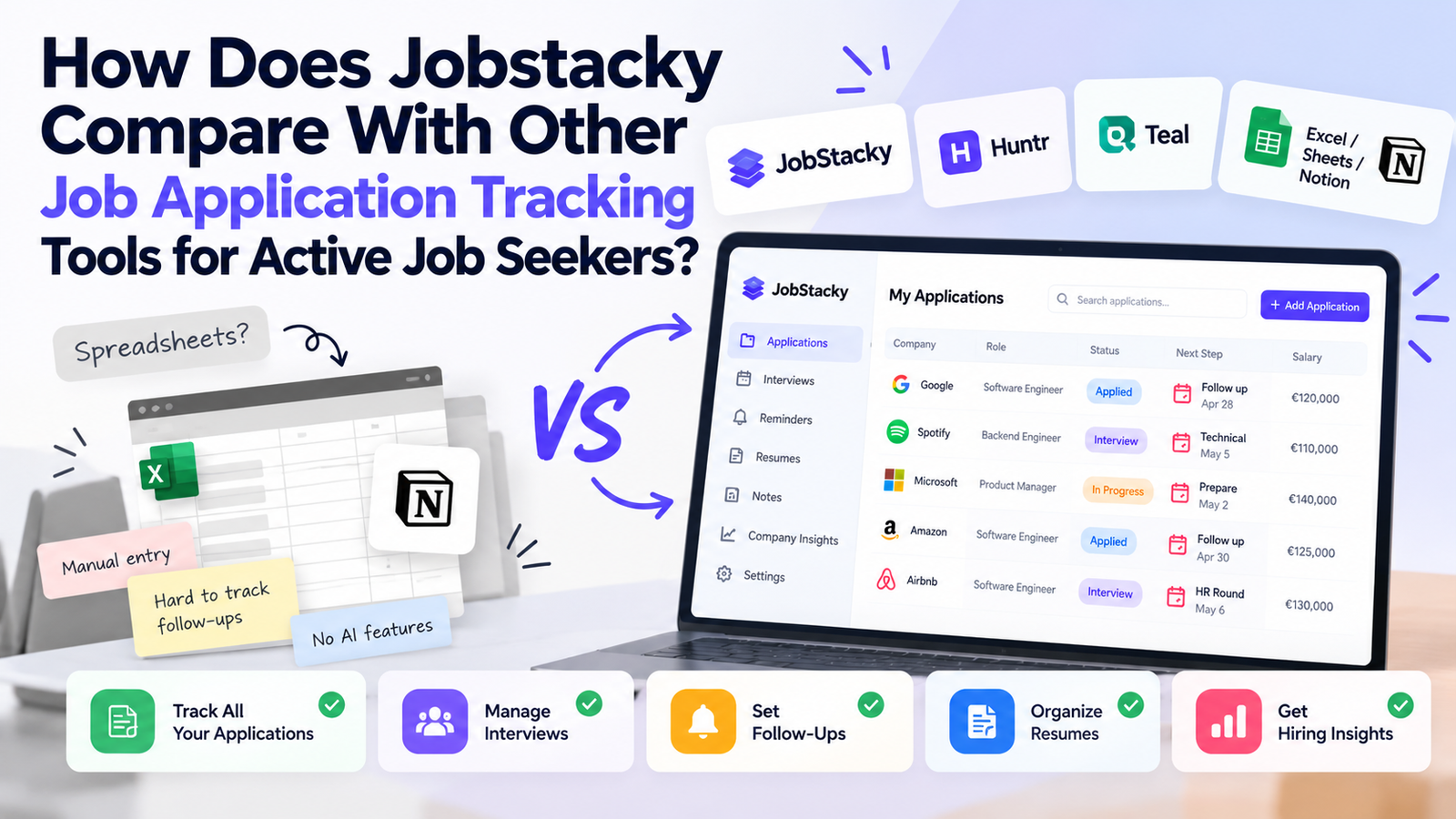
JobStacky vs Huntr vs Teal: Job Application Tracker Comparison
How Does Jobstacky Compare With Other Job Application Tracking Tools for Active Job Seekers?
If you’re sending out applications every week, the tracker you pick starts to matter. Most tools do the basics: a list of jobs, a status for each, maybe a board view. The differences show up when you have 50 or 100 applications in flight, three versions of your resume, and a recruiter calling about a role you applied to a month ago.
This guide compares JobStacky with the tools active job seekers most often consider: Huntr, Teal, and the DIY options, Excel, Google Sheets and Notion. It covers how each handles volume, resumes, AI features and cost, and where each one is the better fit.
What active job seekers actually need from a tracker
Skip the feature lists for a moment. Five things decide whether a tracker still feels useful in week six:
- Room for volume. A cap you hit in week three is a problem.
- Fast capture. If saving a job takes more than a click or two, you’ll stop doing it.
- Resume management. Different roles need different versions, and you need to know which one went where.
- Notes and follow-ups. Recruiter calls, salary figures and next steps need a home.
- A price you’ll tolerate for as long as the search lasts.
JobStacky at a glance
JobStacky combines a job tracker, resume builder, cover letter and outreach drafts, company status tracking and AI tools in one workspace.
- Free plan: €0 with 150 tracked applications, six resumes, company status tracking and daily AI limits that refresh every day (2 to 7 uses per tool). Deleted entries still count toward the limits.
- Pro: €11.99 a month. It raises the tracker to 2,000 applications and 25 resumes, and unlocks unlimited AI features when you connect your own Gemini API key. Without a key you stay on the default free limits.
- Pro Plus: €24.99 a month. It gives higher built-in limits, 20 uses per day per tool, with no key required, plus 30 resumes. Add your own key for effectively unlimited use.
- Custom and Enterprise: for teams and organizations, with 2,000+ tracked jobs, custom integrations and a dedicated account manager.
Other features worth knowing: a Chrome extension that extracts job details only when you click, Excel export for workflows involving the German Federal Employment Agency (Agentur für Arbeit), and community hiring insights on which companies appear to be actively hiring.
Side by side
| Feature | JobStacky Free | JobStacky Pro | JobStacky Pro Plus | Custom / Enterprise |
|---|---|---|---|---|
| Price | €0 | €11.99/month | €24.99/month | Custom pricing |
| Tracked applications | 150 | 2,000 | 2,000 | 2,000+ |
| Resumes | 6 | 25 | 30 | Custom |
| AI usage | 2–7 uses per tool per day | Unlimited with your own Gemini API key | 20 uses per tool per day | Custom |
| Bring Your Own Gemini API Key | No | Yes | Yes | Custom |
| Chrome extension | Yes | Yes | Yes | Yes |
| Company status tracking | Yes | Yes | Yes | Yes |
| Community hiring insights | Yes | Yes | Yes | Custom |
| Excel export | Yes | Yes | Yes | Custom |
| Custom integrations | No | No | No | Yes |
| Dedicated account manager | No | No | No | Yes |
JobStacky’s prices are in euros and the others’ in dollars, so treat the price rows as a rough comparison.
How it differs from Huntr
Huntr is a polished job tracker built around a Kanban board, with a clipper extension, resume tools and, according to some comparisons, strong mobile apps. Its Pro plan runs $40 a month billed monthly. If you care most about board polish and a mobile-first workflow, Huntr is a serious contender.
JobStacky is a better fit when cost is the sticking point or when you want more headroom at the free level. Its free plan tracks 150 applications, and Pro costs a fraction of Huntr’s monthly rate. The trade-off is that unlimited AI on Pro depends on you providing your own Gemini key.
How it differs from Teal
Teal is a career platform centered on resume optimization and job matching, with a job tracker alongside. Teal+ is $29 a month, and the free plan limits daily AI credits. It’s strong if resume tailoring is the main reason you’re shopping.
JobStacky covers similar ground (resume builder, ATS analysis, job fit analysis) and adds company status tracking and community hiring insights. Its paid entry price is lower, and its free tier is larger on tracked applications. If your search is heavily tied to Germany, the Excel export is a practical advantage.
How it differs from spreadsheets and Notion
A spreadsheet is free, flexible and fully under your control. For a handful of applications it’s a perfectly good choice. The cost shows up as volume rises: every listing means copying the title, company, link and description by hand, and reminders only work if you build them yourself.
A dedicated tracker earns its place once you’re applying across multiple boards. JobStacky captures listing details with the extension, prompts you to record your salary expectation when you mark a job as Applied, keeps notes on each record, and stores the resume you used.
A 60-application example
Here’s a hypothetical, not a customer story. A candidate applies to 60 jobs over six weeks, through LinkedIn, Stepstone and company career pages. They keep three resume versions: backend, AI engineering and engineering management.
In week five a recruiter calls about a job from week one. In a spreadsheet, the candidate scrolls through rows hoping the salary figure and call notes were entered. In a tracker, the record shows the listing, the resume version, the salary they quoted and the notes from the first call. The same record can show which applications have gone quiet, so follow-ups don’t depend on memory.
Which one should you choose?
Choose a spreadsheet or Notion if you’re applying to fewer than 20 or 30 positions and like building your own system.
Choose Huntr if you value Kanban polish and a mobile-first workflow, and the price fits your budget.
Choose Teal if resume tailoring and match scoring are your main reason for switching tools.
Choose JobStacky if you’re applying at volume, want a larger free tier, want unlimited AI features at a lower monthly price, are searching in Germany, or want community data on which companies are hiring. Treat that community data as one input and not a verdict, because it reflects what other applicants report.
Laid off? One month of Pro is free
If you were recently laid off, JobStacky is offering one month of free access to the Pro plan. Email support@jobstacky.com and the support team will ask for the details they need over email. The offer is valid until November 1.
Final thoughts
All of these tools can keep a job search organized. The real question is which one you’ll still be updating when you’re 50 applications deep. JobStacky is built for that stage: a free plan that holds 150 applications, a paid tier priced well below Huntr and Teal, and the resume, notes and follow-up tools in the same place.
Ready to try it? Start free at https://jobstacky.com. If you were laid off, email support@jobstacky.com before November 1 to ask about the free month of Pro.
Find Your Next Job with JobStacky
Track up to 150 job applications for free, organize resumes and salary expectations, manage interviews and follow-ups, and explore community insights into employer hiring activity - all in one place.
Start Tracking for Free