
How to Track Job Applications in Germany
how to track job applications in Germany
How to Track Job Applications in Germany: A Practical Guide for International Job Seekers
When you’re applying to dozens of jobs in Germany, keeping track of every application turns into a job of its own.
If you’re an international professional, it’s even harder. You’re sorting out which roles accept your German level, which companies hire in English, and which listings are even still open. You find a role on LinkedIn, apply through StepStone, spot another on a career page, and get a recruiter message a few days later. Multiply that by 50 or 100.
Soon you’re asking: Did I already apply here? Which CV did I send? Who promised to get back to me? And if you’re registered with the Agentur für Arbeit, could you show your records if they asked?
This guide covers how to track applications in Germany, why records matter (especially if you’re registered with the Agentur für Arbeit), and how a tool like JobStacky can help.
1. Why tracking matters in Germany
Germany’s job market is broad: tech, engineering, healthcare, finance, manufacturing, and more. Many employers want German at B2 or C1, especially for roles with customer contact or German-speaking teams. Others, including some international companies and startups, hire people who work mainly in English. Figuring out which is which already takes hours.
Then you still have to manage the applications. Without a system, these problems show up fast:
- Duplicate applications. You apply to the same job twice or forget you already applied to that company.
- Missed follow-ups. You lose track of when a recruiter said they’d be in touch.
- Scattered information. Details sit across LinkedIn, email, career pages, and spreadsheets.
- No clear history. You can’t remember which CV you sent or what was said in an earlier interview.
- Painful paperwork. Someone asks for your job-search records and you have to rebuild them from scratch.
- No sense of who’s really hiring. It’s hard to tell which companies are moving candidates forward.
A tracker gives you one place to see what you’ve done, where each application stands, and what to do next.
2. Why records matter for the Agentur für Arbeit
If you’re unemployed and registered with the Agentur für Arbeit or Jobcenter, keeping records can be more than a good habit. You may need to show your Eigenbemühungen, meaning your own efforts to find work. The exact requirements depend on your situation and on what’s in your integration agreement or other written instructions. Not meeting your obligations can affect your benefits.
Imagine trying to rebuild two months of applications from memory. You’d dig through your inbox, revisit job portals, guess at dates, and work out who replied. You might remember the companies but not the exact titles. Some listings will be gone, and recruiters may have reached you on different channels. That can eat hours. If you tracked from day one, most of it is already done.
Depending on what’s required of you, it helps to keep:
- Employer name
- Position or occupation
- Application date
- How you applied
- Current status
- Relevant emails and confirmations
- Interview invitations and employer replies
Keep copies of the actual evidence too, not just a summary in your tracker.
What about exporting from JobStacky? JobStacky has an Excel export of your application records, which can help you put together a summary when someone asks for one. But the export is a starting point, not a finished document. You may need to add supporting evidence, such as confirmation emails, or reformat the information to match what your caseworker requires. Check it against their instructions before you hand anything over.
A note on the future. JobStacky would like to work with employment services like the Agentur für Arbeit someday, possibly so job seekers could get paid features through a partnership. That is a goal, not a reality. There is no existing partnership or official benefit, and you shouldn’t assume one until it’s formally announced. For now, you can use JobStacky on your own to keep your records organized.
3. A simple workflow for tracking applications
You don’t need anything fancy. Record every application consistently.
Step 1: Save every job you find. Write it down when you find it, even if you haven’t applied yet. Common sources are LinkedIn, StepStone, Indeed Germany, the Bundesagentur für Arbeit’s job search, XING, company career pages, recruitment agencies, referrals, and startup job boards. No single platform has everything. The Bundesagentur’s service lets you save vacancies and set up job alerts. For each job, note the company, title, location, listing URL, and the date you found it.
Step 2: Update it when you apply. Add the application date and change the status. Save the job description and your confirmation email too. This matters when you apply to several roles at one company. A Senior Software Engineer job in Berlin and an Engineering Manager job in Munich have different requirements, recruiters, and timelines, so keep them as separate applications while making it obvious they’re the same employer.
Step 3: Keep statuses consistent. A simple set works: Interested, Preparing application, Applied, Under review, Recruiter screening, Interview scheduled, Interview completed, Offer received, Rejected, Withdrawn, Closed. Only move an application forward when you have a real reason to. Silence from an employer doesn’t mean someone is reviewing your CV.
Step 4: Log recruiter contact. Note the date, the channel, and what was said. If a recruiter says a decision is due by Friday, write it down and plan a follow-up if Friday passes without news.
Step 5: Always have a next action. Your next step might be tailoring your CV, prepping for an interview, sending a follow-up, or waiting for a promised reply. Check these regularly so you keep moving without pestering anyone.
4. What to record
Keep it useful, not exhausting.
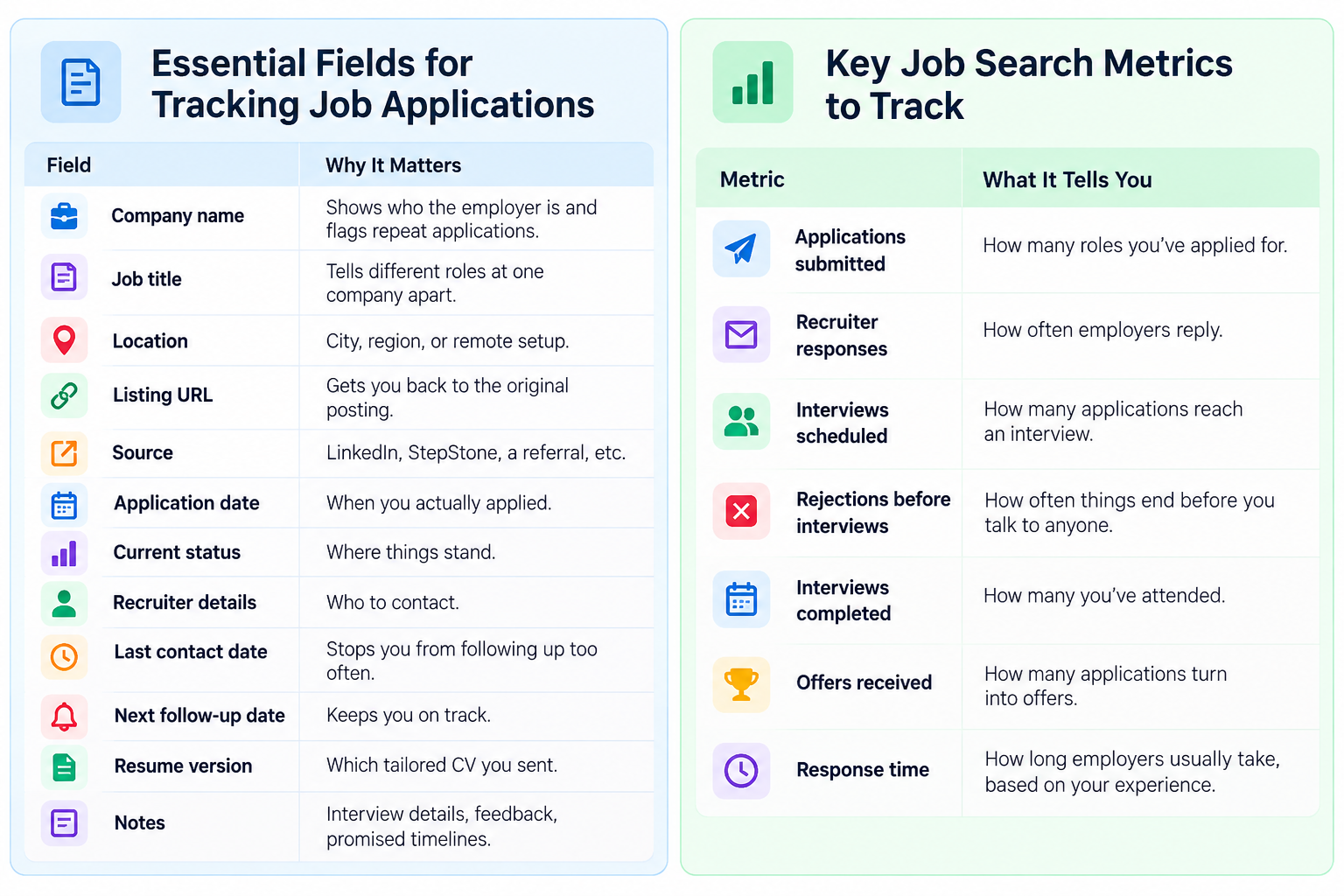
| Field | Why It Matters |
|---|---|
| Company name | Shows who the employer is and flags repeat applications. |
| Job title | Tells different roles at one company apart. |
| Location | City, region, or remote setup. |
| Listing URL | Gets you back to the original posting. |
| Source | LinkedIn, StepStone, a referral, etc. |
| Application date | When you actually applied. |
| Current status | Where things stand. |
| Recruiter details | Who to contact. |
| Last contact date | Stops you from following up too often. |
| Next follow-up date | Keeps you on track. |
| Resume version | Which tailored CV you sent. |
| Notes | Interview details, feedback, promised timelines. |
To start small, company, job title, application date, status, and next action are enough. Add more as your search grows. The point is to make things easier, not to create a second job.
5. Is a spreadsheet enough?
Plenty of people start with Excel or Google Sheets, and that’s a fine start. Spreadsheets aren’t bad. They just take work once you’re applying a lot.
Picture 60 applications over a few weeks. Each time, you open the sheet, copy the title and company, paste the URL, log the date, check whether the company is already there, update the status when someone replies, remember follow-up dates, and keep separate notes on interviews and CV versions. Each step is small. Together they add up.
For a small search, a spreadsheet may be all you need. For a bigger one, a dedicated tool can save real time.
6. How JobStacky helps
JobStacky is a job application tracker built around these problems. Here’s what it does in practice:
- Duplicate checks. JobStacky keeps your application history and checks for duplicate positions and companies. Before you send another application, you can see what you’ve already sent to that employer. It also keeps separate roles at the same company separate.
- Application history in one place. Statuses, dates, and details live together, so you’re not hunting through email and old spreadsheets.
- Resumes next to applications. A CV for a backend role usually differs from one for engineering management. JobStacky brings resume management and application tracking together, so you can see which version went to which job.
- Chrome extension. On a supported job listing page, the extension extracts the job details and adds the position to your tracker, so you copy and paste less. If you reach the AI extraction limit, you can still add jobs manually.
- Excel export. You can export your application records to Excel, which helps when you need to put together a summary (see section 2 for the caveats).
- Community-shared jobs. You can browse jobs shared by other job seekers and add relevant ones to your own workflow. The community is still growing, so how much you find will vary.
You can try it at https://jobstacky.com/
7. The community side: why updating your status helps others
Tracking your own applications is useful. Sharing some of that information can help other people too, and that’s the idea behind JobStacky’s community approach.
A job being online doesn’t mean a company is actively hiring. Roles stay up after hiring slows down, priorities shift, or a process is paused. JobStacky’s company pages and community features aim to give you more context than a listing alone.
Say you apply somewhere and reach the interview stage. If you update your status, it adds a bit to the picture of that company’s hiring. Someone else might see that a person recently interviewed for a similar role and decide it’s worth a look. If people report that a process ended or that they were rejected after interviews, that gives others useful context too.
What this can and can’t tell you. Community reports are a signal, not a guarantee. One person’s experience doesn’t prove a whole company is hiring. Departments, roles, and locations can all work differently. The value comes from more reports over time, not any single one.
Why share with people you’re competing against? Fair question. Job searching is competitive, and not everyone will want to contribute. But more openness about hiring can help job seekers as a group. It won’t guarantee anyone a job or remove competition. It just helps people decide where to spend their time.
Keep it appropriate. Sharing is voluntary. Only share what you’re comfortable making public, and don’t post confidential details about recruiters, interviews, or other candidates.
Where this is heading. JobStacky’s longer-term vision is to show not only which jobs are advertised but also what happens after people apply. A future job portal could help tell the difference between a posted vacancy and one with real signs of active hiring. That’s hard to do well. Companies pause hiring when budgets change or funding gets uncertain, some roles are meant for internal candidates, and others stay online after plans have changed. A system like this would need reliable data, proper verification, and clear explanations of what the evidence does and doesn’t show. A full public job portal like this is a goal, not a finished product.
8. What about AI screening and rejections?
AI plays a growing role in hiring. Some systems help employers analyze applications, spot relevant qualifications, filter candidates, and manage the process. An applicant tracking system might check whether your CV mentions the required experience. If a job asks for five years and your CV clearly shows three, that gap could affect how you’re assessed.
It would be wrong to assume every ATS rejection was made by AI, or that AI never plays a part in rejections. The EU’s AI Act classifies certain AI systems used in recruitment and candidate selection as high-risk, with conditions and requirements attached. Rules and timelines for how this applies are still developing, and practices differ between employers. You often can’t see how automated systems figured into a particular decision.
What you can control is your own process:
- Read the job description carefully before applying
- Check that you meet the essential requirements
- Tailor your CV without stretching the truth
- Record which CV version you sent
- Note interview outcomes and any feedback
- Look for patterns across your applications
For example, if you keep getting rejected before interviews for roles asking for B2 or C1 German, it may be worth checking whether your German matches what those jobs need. That doesn’t prove language was the reason. It’s just a practical thing to look into.
9. Use your data to improve
Once you track applications, you can look back and see what’s actually happening:
| Metric | What It Tells You |
|---|---|
| Applications submitted | How many roles you’ve applied for. |
| Recruiter responses | How often employers reply. |
| Interviews scheduled | How many applications reach an interview. |
| Rejections before interviews | How often things end before you talk to anyone. |
| Interviews completed | How many you’ve attended. |
| Offers received | How many applications turn into offers. |
| Response time | How long employers usually take, based on your experience. |
Don’t treat these as universal benchmarks. A low interview rate might mean your targeting or CV needs work. It might also reflect a tough market, heavy competition, language requirements, or things you can’t control. The real value is asking better questions. Are you applying to roles that match your experience? Do certain job types lead to more interviews? Are you spending time on listings that keep turning out to be a poor fit?
10. A simple weekly routine
Start of the week
- Go through saved vacancies and job alerts
- Pick roles that fit your skills and requirements
- Prioritize by how well they suit you
After each application
- Record the company, role, and date
- Save the listing URL and your confirmation
- Note which CV version you used
- Set a follow-up reminder if it makes sense
When you get a reply
- Update the status
- Log what the recruiter said
- Add interview dates and promised decision times
- Save any useful feedback
End of the week
- Check which applications need a follow-up
- Prep for upcoming interviews
- Make sure your records are complete
- See which sources and role types are giving you the best leads
Frequently asked questions
What’s the best way to track job applications in Germany?
Use a central spreadsheet or a dedicated tracker. Record the company, job title, application date, status, recruiter details, and next action. Keep relevant correspondence and update the record whenever something changes.
Which job portals should I use?
Start with LinkedIn, StepStone, Indeed Germany, the Bundesagentur für Arbeit’s job search, and company career pages. The best mix depends on your industry, experience, location, and language level.
Do I need to track applications for the Agentur für Arbeit?
It depends on your situation and the instructions you’ve received. If you have to document your job search, keep accurate records and follow what your Agentur für Arbeit or Jobcenter contact tells you.
Is Excel enough?
Yes, for a small number of applications. A dedicated tracker gets more convenient when you have many applications, want to avoid duplicates, keep interview notes, and organize resume versions.
How does JobStacky help?
It helps you organize applications, track statuses, keep a history, check for duplicates, and manage resumes alongside your applications. The Chrome extension can pull job details from supported listing pages, and you can add jobs manually too.
Can JobStacky help me prepare records for the Agentur für Arbeit?
It has an Excel export of your application records, which can help you organize your information. You may still need to add supporting evidence or adjust the format to match your caseworker’s requirements.
Does JobStacky have an official partnership with the Agentur für Arbeit?
No. A possible collaboration is part of JobStacky’s future vision, but nothing exists today. Don’t assume it’s officially endorsed or that paid features are available through the agency.
Can I see which companies are actively hiring?
JobStacky’s company pages and community features aim to help you explore hiring activity. But an advertised role or one person’s experience doesn’t guarantee a company is actively recruiting.
Why should I update my status for the community?
Sharing selected status updates can help other job seekers understand reported hiring activity. It’s voluntary, and individual reports should be read carefully since processes vary.
Final thoughts
Finding a job in Germany isn’t about sending the most applications. It’s about managing your time, seeing how you’re doing, and knowing what happens after you apply. For international professionals, that’s harder when language expectations, hiring processes, and application channels differ from one employer to the next.
A simple tracking system helps you keep your history, avoid duplicate applications, prepare for interviews, and have your documents ready when you need them. JobStacky aims to put applications, resume management, and community hiring information in one place. Our longer-term goal goes further: a more transparent job search where people learn from shared experiences and decide more wisely where to apply.
If you’re job hunting in Germany, start by tracking your applications consistently. You can check out JobStacky at https://jobstacky.com/.
Related posts
I Lost My Job in Germany. The Biggest Problem Wasn't Finding Jobs - It Was Keeping Track of Them.
June 29, 2026
I Lost My Job in Germany. The Biggest Problem Wasn't Finding Jobs - It Was Keeping Track of Them. I thought finding a job would be the hard part. I was wrong. ...
How to Follow Up on a Job Application: Timing, Examples and Email Templates
October 6, 2026
How to Follow Up on a Job Application: Timing, Examples and Email Templates You hit submit on the application. Then nothing. Days go by, maybe weeks, and you st...